Lee aquí la versión original en español de este reportaje sobre la gestión de Consuelo Porras Consuelo Porras Argueta de Porres's name did not appear on the first list of …
Lee aquí la versión original en español de este reportaje sobre la gestión de Consuelo Porras
Consuelo Porras Argueta de Porres’s name did not appear on the first list of candidates for attorney general in the 2026 elections. Nor on the second, despite an injunction that the Constitutional Court granted to Raúl Falla, of the Foundation Against Terrorism, to repeat the vote.
If everything proceeds as it should, Gabriel García Luna — the attorney general appointed by Bernardo Arévalo — will take office on May 17, 2026, and Consuelo Porras will step down from the Attorney General’s Office.
She is expected to leave behind a gutted institution. With the prosecutorial career track weakened and dozens of people criminalized over her eight years in office.
Porras also leaves behind other troubling questions: dismissals of dubious legality and allegations of workplace abuse.
Justice as a weapon
First came former employees of the Attorney General’s Office who had investigated corruption and impunity cases. The Porras administration opened dozens of criminal cases against them.
But they were not the only ones targeted. The reach of the criminalization soon extended beyond her own institution. The Inter-American Commission on Human Rights (IACHR) and the United Nations High Commissioner for Human Rights have noted that under her tenure, justice operators, journalists, human rights and land defenders, and political opponents were criminalized.
«She eliminates whoever she considers a political enemy or whoever opposes her hold on power,» says David Gaitán, a former official of the International Commission Against Impunity in Guatemala (CICIG). The Porras administration criminalized Gaitán, who now lives in exile.
In the absence of an official registry of criminalized individuals, the figures vary. Brenda Guillén, general coordinator of the Unit for the Protection of Human Rights Defenders in Guatemala (Udefegua), explains that the numbers depend on how criminalization is defined.
«Most people understand criminalization as the improper use of the law to generate an arrest warrant. But at Udefegua, we conceive of the process as beginning with hate speech, stigmatization, and defamation. It escalates from there, eventually leading to an arrest warrant and arbitrary detention,» Guillén explains.
Udefegua’s experience shows that criminalization from the Attorney General’s Office predates Consuelo Porras — but it intensified sharply under her administration.
Mass firings
The criminalization was the visible face of a reality concealed behind the walls of the Attorney General’s Office.
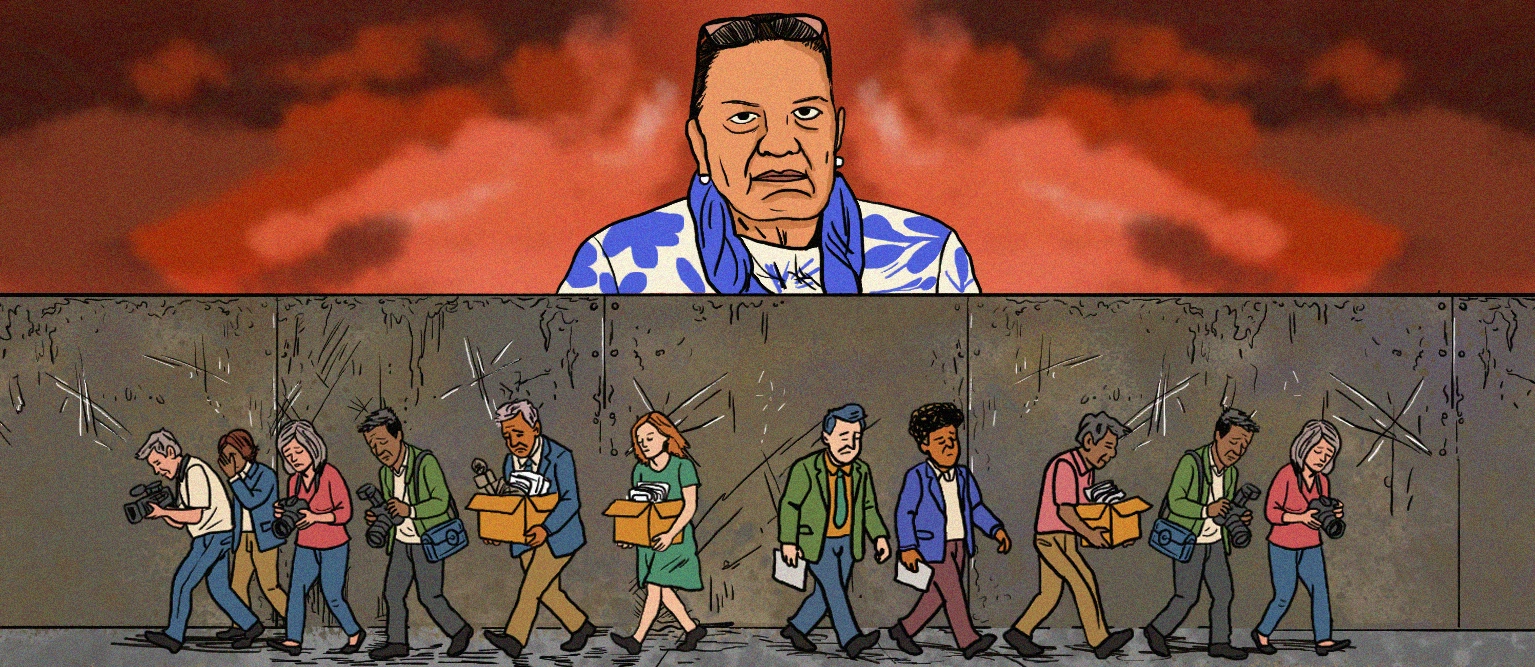
From 2018 to 2025, during the Consuelo Porras administration, the office fired 571 workers. The years with the highest number of dismissals were 2023 (135) and 2025 (110).
The data — obtained through public records requests — shows that over the past 20 years, dismissal rates peaked under the Porras administration.
Among the 571 people fired were the heads of the personnel development, procurement and bidding, integrated management systems, public information, evaluation, accounting, and treasury divisions.
Beyond division heads, the dismissals also included coordinators of the victimology legal area, disciplinary procedures, field data collection, systems and communications, development and production, and the Criminal Investigation Directorate (DICRI).
Nearly half of those fired were staff responsible for investigating and litigating cases. Under Porras, 275 members of the prosecutorial staff were dismissed.
In February 2026, Agencia Ocote requested information about the dismissals, but the office denied it, citing the personal data of those involved. Yet in November 2025, the office had provided Agencia Ocote with the removal order for prosecutor Edgar Gómez — the attorney who secured the conviction in the Hogar Seguro case, and who was dismissed without any specific disciplinary grounds, according to documents reviewed.
Given the denial of access to public information, it was impossible to verify how many of the 571 people were dismissed without justification.
A broader picture, however, can be drawn from a 2025 study by the Institute for Comparative Studies in Criminal Sciences and the Alliance for Reform, which analyzed the performance of the Attorney General’s Office under Consuelo Porras.
The report found that of 105 prosecutors dismissed between 2021 and 2025, only 20 were removed through a formal disciplinary process. The remaining 85 were dismissed without cause.
In their place, Porras installed loyalists in key positions within the Attorney General’s Office.
With me, or against me
Fear was a constant in the hallways of the Attorney General’s Office. Four current employees and two former employees spoke with Agencia Ocote on condition of anonymity. They described prosecutors and senior officials who were dismissed after refusing to sign a document pledging personal loyalty to Attorney General Porras.
Agencia Ocote attempted to obtain this document. Both current and former employees explained that they had not kept a copy — and had been unable to photograph it, since personal phones were not permitted inside the attorney general’s office when they were called in to sign.
Employees also reported that opposing an instruction — or simply questioning it — became grounds for dismissal. According to the testimonies gathered, some instructions diverged from the technical findings of investigations and appeared designed to harm or benefit specific individuals, at the attorney general’s discretion.
«The last four years have been agonizing. Ever since the mass firings began, nobody has had any peace. Every time someone gets a call from Attorney General’s Office headquarters, they think they’re about to be fired,» said one employee.
The employees consulted by Agencia Ocote agreed that fear of retaliation has shaped their daily decisions. Sharing a post or a critical cartoon about Porras on a WhatsApp status, expressing support for the demonstrations during the 2023 National Strike, or having any contact with journalists who scrutinize the Attorney General’s Office had all become risks.
Juan Francisco Sandoval was one of the first prosecutors to experience this kind of dismissal. On July 23, 2021, the former head of the Special Prosecutor’s Office Against Impunity (FECI) was notified of his dismissal after objecting in writing to a verbal order from the attorney general. In the removal order, Sandoval was classified as «confidential personnel.»
«What she wants is vassals,» said Virginia Laparra, a former FECI prosecutor who was jailed and now lives in exile. «The moment someone refuses to do everything she says, she discards them. It’s a deeply unhealthy dynamic.»
Laparra recounted that before Sandoval’s dismissal — when he was still her superior — the attorney general offered her his position. Laparra declined. «She told me: ‘If you’re not with me, you’re against me.’ After that, they set their sights on criminalizing me.»
The prosecutorial career, destroyed
Sandoval argues that when Porras began carrying out direct, unjustified dismissals, she repeatedly violated the law and utterly destroyed the prosecutorial career track.
«The Organic Law of the Attorney General’s Office establishes a professional career structure. Employees who belong to that career track entered through a competitive merit-based process — they took examinations. Under that same law, any dismissal must be preceded by an administrative procedure,» Sandoval said.
Claudia González, an attorney with extensive experience in corruption and impunity cases, noted that «years of investment had been made in training, and there were highly skilled people at the office.»
«The state and the international community had invested in making this institution work. It was developing — not as fast as anyone would have liked, but real changes were happening. In one fell swoop, all of that was erased,» González said. She too was targeted: the Porras administration opened a case against her for abuse of authority, despite the fact that she had never held public office.
Title V of the Organic Law of the Attorney General’s Office, in articles 60 through 81, sets out the infractions and disciplinary procedures applicable to staff.
Carlos Sacalxot, a lawyer and notary with 50 years of experience in labor rights defense, analyzed the situation. He explained that if an employee entered through a competitive merit process, that constitutes an administrative career track — and with it, permanent employment status.
«My view is that if an employee moves into a position of trust, but entered through a competitive process and won that competition, the law itself establishes that acquired rights must be respected,» Sacalxot said.
He added that the problem is that the law is always open to interpretation — and in many cases, that interpretation is bent to serve political ends.
The collective labor agreement that sources identified as the basis for dismissing staff without prior disciplinary proceedings had a validity of 30 months from the date of signing. It expired in September 2023 — but remains in effect because the agreement itself stipulates that it continues unless formally denounced.
Agencia Ocote requested public information to determine whether a new negotiation of the collective agreement was underway, but the Attorney General’s Office denied the request. The outlet also contacted the office’s communications department to ask for an explanation regarding the unjustified dismissals, the use of the collective agreement to carry them out, the allegations made by workers against Attorney General Porras, and the reasons why her administration recorded the highest dismissal numbers in the office’s 20-year history.
María José Mansilla, spokesperson for the office, replied by text message that «the administrative and labor decisions adopted by the institution are made in strict adherence to the rule of law, due process, and applicable regulations.» She added that collective agreements are not unilateral decisions, but accords reached by both parties.
The new attorney general’s agenda: rebuilding the career track and restoring trust
Analysts consulted agreed that García Luna’s first priority as the new attorney general should be to conduct a thorough assessment of the state of the institution. On the issue of criminalization, David Gaitán stressed the need to determine exactly how many people have been targeted.
«They should review every criminalization case, and in carrying out that review they will find how many of them were fabricated. And not only untangle the criminalization cases in favor of victims — they also need to determine who should be held accountable for the way those investigations were handled and those prosecutions were carried out,» Sandoval said.
Claudia González recommends starting with a full accounting of the office’s existing staff. In her view, there are still prosecutors with the experience and the will to do good work — though key positions must be carefully examined, including those filled by Porras loyalists.
Ana Lorena Delgadillo, of the Panel of Independent Expert Persons — a group of professionals that analyzes and evaluates selection processes — emphasized that the new head of the office will need to build a strong team of people genuinely committed to integrity and democracy.
«It will be very important to review the internal oversight and disciplinary system — to understand how all of these procedures will be carried out within a framework that respects labor rights,» Delgadillo said. «Teams that inspire real trust, and that can in turn build trust both inside the institution and beyond it.»
According to the experts consulted, in order to begin addressing the issue of impunity, the new attorney general will also need to review the files of individuals implicated in corruption cases who were shielded under the Porras administration — to determine which cases are final and closed, and which ones can still be legally challenged or appealed.
«The Attorney General’s Office is an institution that has to function every single day,» Delgadillo concluded. «It will have to operate in a state of emergency while simultaneously carrying out reforms — at the same time.»
This article was originally written in Spanish. The English translation was produced with AI assistance and reviewed by the Agencia Ocote editorial team.