By: Alex Maldonado and Alejandra Gutiérrez Since returning home, 1,295 days after being captured and imprisoned, José Rubén Zamora has not had much rest. The 69-year-old journalist, founder of elPeriódico, …
By: Alex Maldonado and Alejandra Gutiérrez
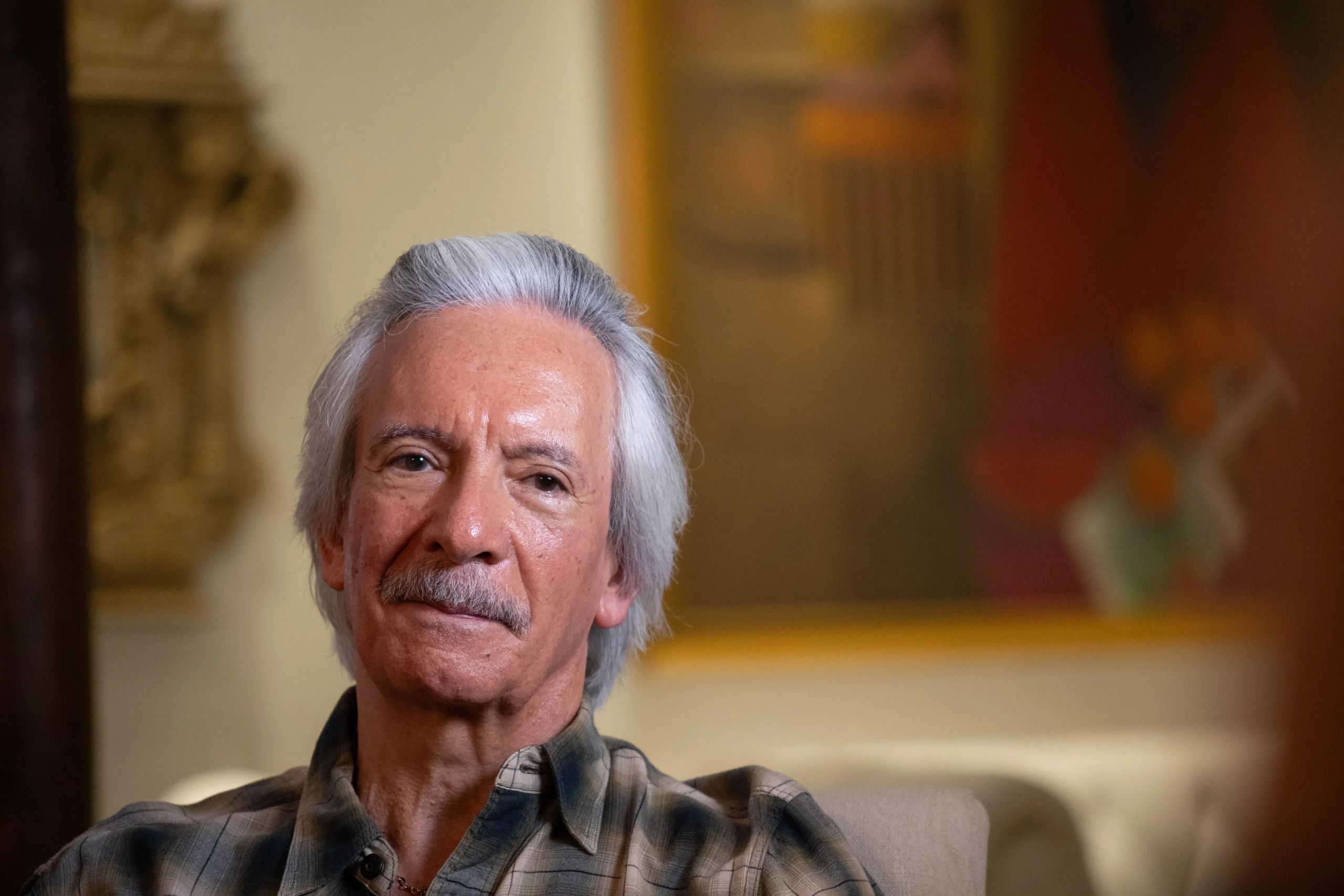
Since returning home, 1,295 days after being captured and imprisoned, José Rubén Zamora has not had much rest. The 69-year-old journalist, founder of elPeriódico, says there’s a high probability they’ll ‘send him back’.
He lives on the edge, against the clock. One foot in his bright house, with its high ceilings, its art-covered walls and its wooded backyard, and the other in the cell where, he insists, he was held captive by the state and tortured.
Although Judge Máximo Morales granted him house arrest, the sword of Damocles still hangs over his head. Zamora knows that the Public Prosecutor’s Office and the Foundation Against Terrorism (Fundación Contra el Terrorismo; FCT) will continue to obstruct his case.

Zamora isn’t wasting any time. He has given some fourteen interviews, scheduled a medical check-up, and took the opportunity to request the cancellation of the FCT—the Fundaterror, as he calls it— before the Registry of Legal Entities.
Despite everything, he is cordial and seems calm. The only signs of his confinement are his thinness, which he hides with baggy jeans and a plaid flannel shirt, and an almost imperceptible slowness as he climbs the stairs.
He is in no hurry to finish the interview he is giving to a European media outlet, before the one with Agencia Ocote. Afterward, and after saying goodbye, he helps arrange the chairs, offering his house as a set: ‘Choose the spot you want’, he tells the journalist with the camera.
While the lights are being set up, Zamora embarks on a whirlwind tour through a résumé of misfortune: all the threats, the surveillance, and the attacks he has suffered in his 36 years as founder and director of two media outlets, which are now part of the little-told history of Guatemalan journalism.
Hitmen, surveillance in helicopters and in cars, calls in the early morning hours, a kidnapping that almost cost him his life. All at different times and under different governments. He now lists the harassments, which he always reported on in the pages of the newspapers he led.
Prison, you could say, is the latest episode of a series in which, with each season, the number of enemies accumulates – those who were the subjects of the published investigations. He estimates he has at least three more years of legal proceedings in order to get out of this Kafkaesque case against him.
‘But you decide to keep going. You decide you have to keep going every hour. I had to learn to think about the next 24 hours. That’s how I learned to survive.’
You learned to live in 24-hour periods, locked up…
I understood that my children’s world was different, and that mine was different too. I built a small universe.
How would you describe that small universe?
I felt like a living corpse. That for an indefinite period I was witnessing my own agony. Books were important to me. Thank God, I had access to books. I must have read about 7,000 books. I read Tolstoy, Dickens, Kundera, Rulfo, García Márquez, Julián Marías, father and son… But the one that struck me the most was La condición humana (Man’s Fate) by André Malraux. I read that book as if I were watching a movie. And, after that book, I saw everything that way. That is, I escaped from my body and was seeing the book projected on the wall.
Now you’re released, but coming to an empty house. Without your family, who are in exile, do you feel alone?
Well, the truth is, I’ve never felt alone. I’ve always felt them with me.
This is now more metaphysical, but in the cell I even felt the presence of my grandmother and my two mothers. A friend died, and I felt it. The next day they told me he had died. I wrote a piece about him.
Despite everything, you kept writing.
By hand – pages and pages that are already typed up but haven’t been published yet.

You have said that you are certain they are going to send you back to prison. In a way, you’re living against the clock. Why are you dedicating this time to giving interviews?
I think there’s a high probability that they’ll send me back – over 70 percent. Maybe, all of a sudden, something unforeseen happens and they don’t take me, but I see that as unlikely. And why am I giving interviews? Well, like you, I was in the media and I sought out interviews because it felt important.
So I can’t refuse to meet with anyone. On the contrary, I appreciate it. First, because I know that if they ask, it’s because they think it’s important, and second, I wouldn’t be out now without the support of the independent press, not only in Guatemala, but in the region and in the world. They have all been key to my release.
It’s possible that with the shift in the balance of power that has happened, I might remain here, but I think the visceral hatred they have for me is very strong. I regret this, but I wouldn’t do anything different either. Knowing the outcome of my life, I would do it all again.
You asserted that Guatemala was the perfect labyrinth, but, like as a fractal, it seems your case is also that perfect labyrinth. It feels that the legal process against you offers you no exit.
But there is a way out. I have evidence for everything. I think those two cases are going to fall apart very quickly. In the influence-peddling case, the Public Prosecutor’s Office presented no evidence and the judge declared me innocent, despite all of Giammattei’s power.
In the blackmail case, they didn’t present a single witness. Just now, the judge who released me called the prosecutor’s attention to this and said, ‘Look, Zamora and his defense don’t have to prove his innocence. You have to prove that he is guilty’. But they’ve been sharp, because at one point even I thought I was guilty of something (he says laughing).
And, in addition to giving interviews, you filed a lawsuit against the Foundation Against Terrorism [Fundación Contra el Terrorismo – FCT].
We must find a way to take it off the table so that Guatemala can have a decent and prosperous future. And yes, it was a high priority, although I was a little hesitant.
I filed this lawsuit against the organization but, at the same time, and having seen them, I believe I could never hold a grudge or hate them because I know they are sick people. They are people with psychological problems. They are sadistic in a clinical, precise, and strict sense.
It is paradoxical that one of the men you speak of, Ricardo Méndez Ruiz of the FCT, was a columnist for elPeriódico.
Although I have promoted and supported pluralistic public debate, including people whose writing I disliked, I always supported the idea that their writing and thoughts could be printed in the newspaper. In the case of Méndez Ruiz, I personally opposed it for a thousand reasons.
All of a sudden, I saw that he was published so, when I took full control of the newspaper, one of my first decisions was to ask for him to be removed.
I hadn’t thought about it, but now that you mention it, I suddenly realize I should have let him stay. Perhaps his frustrations would have continued to be published. It’s better that he wrote down his horrific thoughts, that he vent his frustrations through his writing, than what we’re seeing now, causing so much harm to society.
He has destroyed reputations, ruined fortunes, and torn families apart but I also think that Méndez Ruiz’s power is overblown.
It’s said that he doesn’t act alone, but rather represents a structure with financiers who have never been made public.
He rose to prominence because he was financed by people who were very important economically and financially. However, today I believe he has his own independent source of power. Both Méndez Ruiz and (Raúl) Falla are each already millionaires.
It was reported that Falla bought a property in Marina del Sur, a very exclusive residential area. That’s for multimillionaires. For the vulgar among the wealthy.
In time, this could backfire on those who financed them but it must be acknowledged that fascism prevails among the Guatemalan elite.
Tell us more about these elites.
It’s regrettable, but there are no people here with deep democratic convictions. They have neither convictions regarding freedom, democracy, transparency, the rule of law, nor respect for human rights. Their political affinities have been with authoritarianism, hierarchy, privilege, and extreme mercantilism.
Do you believe that these business elites have been behind the Foundation since its inception, or that they continue to be so?
When I speak of elites, I also refer to academic elites, military elites, and other social and pressure groups and, of course, there are elites in the business sector as well. Among these elites are some very powerful people who are fascists.
This includes some, who aren’t extremists, who don’t even realise that communism ended with the collapse of the Soviet Union.
In Guatemala, with the signing of the peace accords, they said, ‘Let’s embrace democracy’. It was a transition from authoritarianism to democracy, without even understanding what democracy is or what it means. It’s just a very superficial veneer of democracy.
That said, other groups have been profoundly democratic, and what we must do is continue to put faith in democracy.
What is the state of democracy in Guatemala?
To be locked up and to see the people from the 48 Cantons arrested was a shock. How is that possible? We’re talking about the 48 Cantons who took to the streets to defend democracy in the 2023 elections.
It’s sad and depressing to see that progressive right-wing groups are not calling out, ‘Come on, it’s a success! That people who have received nothing from the State, who are marginalized, are the ones coming out to defend and march for democracy’.
They should have set off fireworks instead of throwing them in jail. Groups that are never listened to, they come and march in the city to defend a democracy that only benefits the wealthy and the middle class. It’s unacceptable, monstrous. It’s fine that they’re going after me, but they, they should have been applauded.
Perhaps what they want again is a return to fascism.
[Then, Zamora launches into a rapid-fire tour about migration, about a system that has expelled millions of Guatemalans, about the armed conflict, about the signing of the peace accords, about the role of the United States in the conflict…]
You mention the United States, their embassy in particular. We understand that you always had contact with them. You are critical of the United States’ role during the war, but what is your assessment of the U.S. embassy in your own case?
I believe I am alive and sitting here because I have had the support of the embassy. Since 1989, if I hadn’t died, if I hadn’t been assassinated, it has been, in part, thanks to the embassy.
We have had exceptional ambassadors, like Mr. Tom (Thomas) Stroock, like Mr. (Stephen) MacFarland. I had no contact with the embassy during, for example, Portillo’s time.
Personally, they would tell me, ‘Don’t give in, don’t let your guard down, your work is excellent, you can count on us.’ That felt like an endorsement, and so we continued working.
Then, with (William) Popp (from 2020 to 2023), foreign policy was simply tweets, and when I was imprisoned, Popp disappeared. But there were people at the embassy who fought for me. But that doesn’t change my opinion that the approaches taken in previous years have caused those migrations that Mr. (Donald) Trump now opposes.
It’s a fact that there have been serious blows against the media leading to your your imprisonment. We can add to that journalists forced into exile, and the closure of elPeriódico. There has been persecution and criminalization. How would you describe the state of the press in Guatemala?
The situation is very complex, especially financially. We are in a transition, and there is an enormous risk for all media outlets. There can be no democracy without freedom of expression, and there is no freedom of expression without independent media.
Prensa Libre continues, in its own way, but with fewer and fewer resources and advertisers. Despite this, I have seen them maintain their pluralism and, in my case, support me very strongly, which could have even cost them their publication. I see other very strong media outlets with a lot of experience, but they always have the problem of where to get funding. There is a need to guarantee some kind of financial structure.
That said, big business already has its own media outlet, which is República GT, and with that, they feel they don’t need anyone else to survive.
In a 2015 interview with Plaza Públicayou said, regarding the death threats you had received, that «the houses where my death and that of elPeriódico would be most celebrated would not be the presidential residence, but the homes of very important people with traditional capital and some heads of organized crime». Do you still think that there are people with traditional capital and heads of organized crime celebrating your persecution?
Friends, prominent businesspeople, came to see me in jail, and, so they told me, many businesspeople were saying, ‘Well, it’s true, he didn’t commit any crime, but it’s a good thing that he’s in jail’.
Do you have more friends than enemies?
More friends. More friends.
Monsters have been created.
Everything needs to be cut down. Yes.
Returning to your application for the cancellation of the FCT’s legal status, do you expect the Arévalo government to do something?
I am certain that it will, because his conviction is to respect the law from any perspective and he respects the law utterly. Perhaps that will be his legacy.
What I presented is in a regulation for NGOs that Giammattei created, surely with Fundaterror’s advice. Life is full of contradictions. The regulation states exactly that if you don’t comply with your statutes as an NGO, you have to cease to exist, and it gives a deadline. All the types of actions and atrocities they (the FCT) have committed are documented.
You founded and led two leading media outlets (elPeriódico and Siglo Veintiuno). So, in retrospect, what do you consider to be your legacy?
I always saw the possibility of prison as an option. It was a scenario that was always just around the corner. The other was that I could be shot, that my children could be harmed, or an advertising boycott.
I viewed each new government as a kind of cycle. The first year would begin, and I already knew what they were like; the second year, what they would do; the third, I had to endure until the fourth. Each time it ended, I felt like a Vietnam War veteran. They always ask me how I feel and I’d say, ‘Man, I feel like I’m 150 years old’.
And the legacy?
Perhaps courage, the refusal to give up. If necessary, just sitting in a chair, enduring the pressure. Like those jade stones that contain what is supposedly dinosaur DNA. You have to know how to fossilize yourself, to remain there and to resist.
To carry on.
Resist, resist. When the wave comes, the crosscurrent, rivers, tsunami, or whatever, you have to let go. That ruined me at first. Sometimes, you have to let go to better survive. You have to float with the water. Don’t confront it. When the force is already greater than you, you have to let go and not fight. If you fight, it’s worse for you.
But, there is no flash flood, no hurricane, no tornado, no Mitch, no Ríos Montt that lasts forever. Sooner or later they disappear. And you have to keep going. Right?
Written by: Alex Maldonado and Alejandra Gutiérrez
Edited by: Carmen Quintela
Photographs by: Christian Gutiérrez
Translation: Kevin O’Dell | Guatemala Solidarity Network